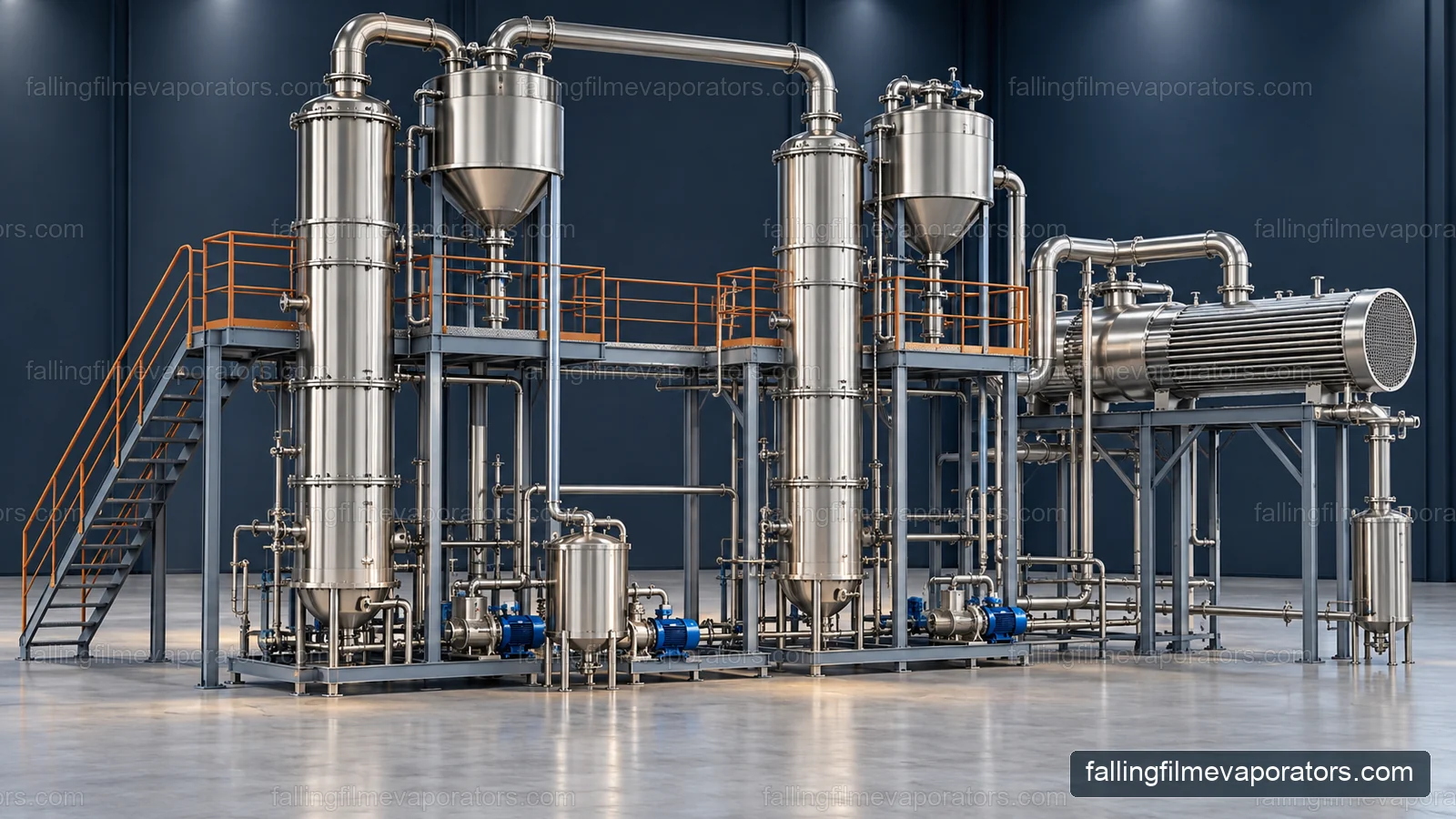
Two-effect falling film evaporator for food liquids
Two-effect falling film evaporators for food-liquid concentration. Compare temperature profiles, product routing, inter-effect vapour use and utility demand.
Where this arrangement fits
A two-effect arrangement is worth evaluating when vapour from one evaporation stage can provide useful heat to the next. It is an equipment configuration, not a guarantee of a particular capacity or steam ratio. Product sensitivity, available heating temperature and the final concentrate viscosity determine how much useful temperature difference is available.
Discuss this configuration ↗Start with feed kg/h, inlet and final concentration, operating hours and utilities.
How the arrangement works
Vapour produced in the first effect supplies the heating side of a lower-pressure effect. The pressure steps provide the temperature difference needed for heat transfer. Feed may follow a forward, backward or mixed product route according to the application; a two-vessel image does not establish the actual product routing.
Explore distribution, heat transfer and separation ↗What changes in the equipment decision
Compared with one effect, two effects introduce additional heating surfaces, piping and pressure-control interactions. They can recover heat that would otherwise go to condensation, but the heat balance must include feed heating, boiling-point elevation, losses and any condensate or vapour recovery. The final effect still needs adequate wetting and product discharge.
Specify these conditions
- Heating and boiling temperatures for each effect
- Product routing and final-pass viscosity
- Inter-effect vapour quality and carry-over control
- Condensate separation, vacuum duty and cooling-water basis
- Footprint, service access and start-up sequence
Confirm the feed distributor, heating surface, separator, vacuum interfaces, concentrate pumping and cleaning provisions against the normal and minimum loads. A proposal should state the inclusions and exclusions explicitly.
Prepare the utility information ↗A common selection question
Does two effects mean twice the evaporation capacity?
No. Effect count describes heat reuse. Evaporation capacity follows the specified water-removal duty, heating area, temperature differences and operating conditions.
From configuration to a project proposal
Send a representative product description and the operating data you have. The engineering review should resolve suitability, heating area, temperature profile, materials and utility consumption before a model or guarantee is agreed.
Ask for identified equipment photographs, dimensional drawings and a rated duty in the proposal. Acceptance should cover the agreed operating and product-quality conditions; successful enquiry submission is not equipment approval.