MVR falling film evaporator for food liquids
MVR falling film evaporators with mechanical vapour recompression. Evaluate electricity, vapour lift, boiling-point elevation, carry-over and operating range.
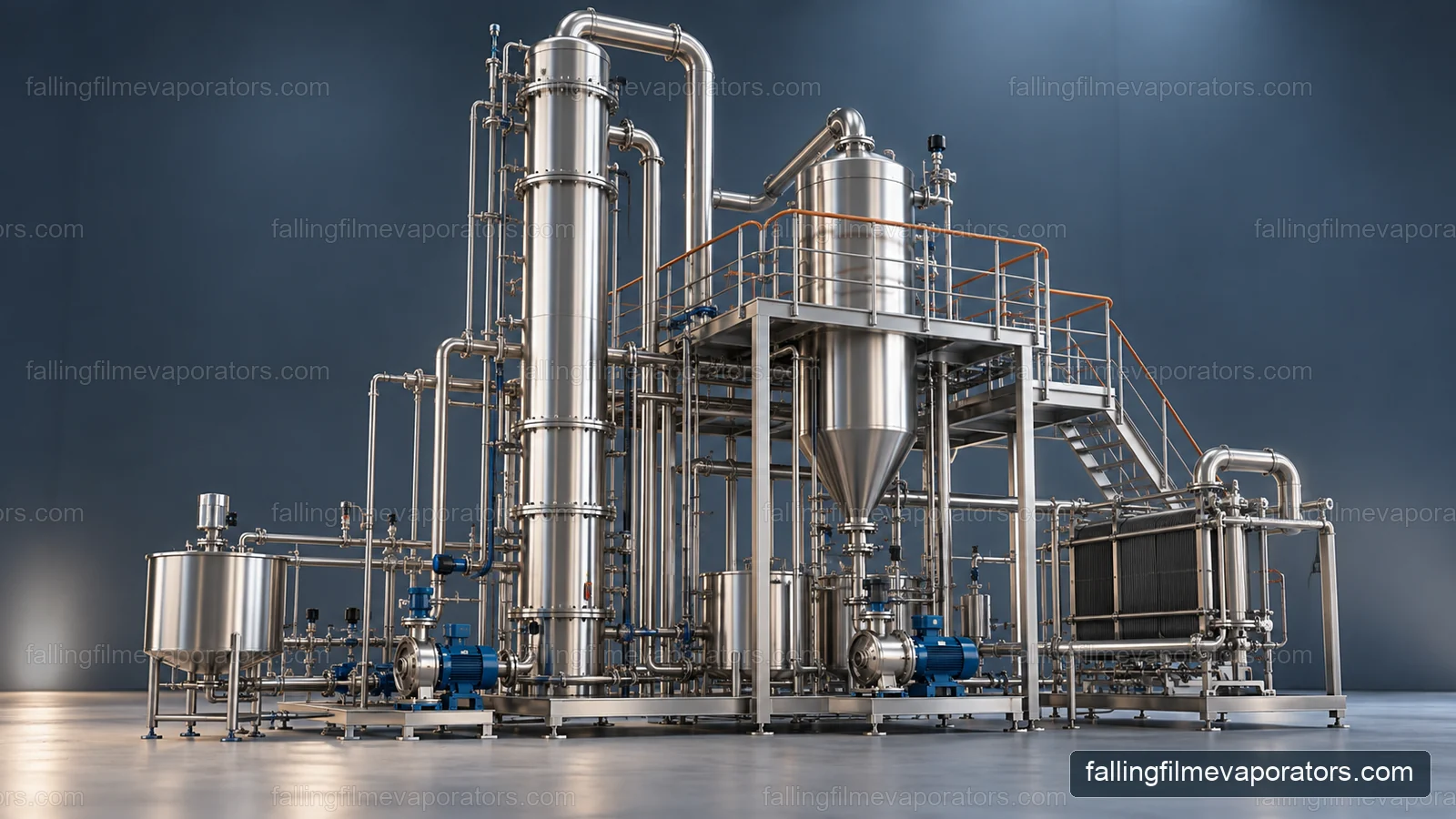
Where this arrangement fits
MVR should be evaluated where recovered vapour can be mechanically compressed to provide the temperature lift needed for heating, and where electrical infrastructure and operating economics support that approach. It is a heat-recovery choice and does not, by itself, specify the number of evaporation effects.
Discuss this configuration ↗Start with feed kg/h, inlet and final concentration, operating hours and utilities.
How the arrangement works
A compressor raises the pressure and saturation temperature of recovered vapour. The upgraded vapour is returned to the heating side of the evaporator. Compressor selection must consider vapour flow, required lift, entrained droplets, non-condensable gases and stable operating range. Start-up and supplementary heating belong in the utility schedule.
Explore distribution, heat transfer and separation ↗What changes in the equipment decision
An MVR proposal moves a significant part of the energy discussion toward electricity and compressor operation. It does not justify a universal zero-steam or energy-saving claim. Include start-up utilities, motor and drive requirements, cooling, controls, noise and maintenance when comparing it with steam-heated alternatives.
Specify these conditions
- Required vapour flow and compressor temperature lift
- Boiling-point elevation and heat-transfer driving force
- Separator carry-over and protection of the compressor
- Electrical capacity, drive control and operating range
- Start-up heating, maintenance access and spare-part scope
Confirm the feed distributor, heating surface, separator, vacuum interfaces, concentrate pumping and cleaning provisions against the normal and minimum loads. A proposal should state the inclusions and exclusions explicitly.
Prepare the utility information ↗A common selection question
Does an MVR evaporator need no steam at all?
That cannot be assumed. Start-up, supplementary heating and process conditions may require external heat. The proposal should state each utility and its operating basis.
From configuration to a project proposal
Send a representative product description and the operating data you have. The engineering review should resolve suitability, heating area, temperature profile, materials and utility consumption before a model or guarantee is agreed.
Ask for identified equipment photographs, dimensional drawings and a rated duty in the proposal. Acceptance should cover the agreed operating and product-quality conditions; successful enquiry submission is not equipment approval.